
How Denmark, a Country of 6 Million, Became the Center of the Design World


You walk into a loft in Brooklyn, a café in Tokyo, or a flat in London and you see it: the teak sideboard with tapered legs, the PH lamp casting its soft glow, the Wishbone chair around the dining table.
None of it looks new. But it’s everywhere. And almost all of it traces back to Denmark in the 1950s and 60s.
Denmark has 6 million people. For context, that’s smaller than Los Angeles County. Yet for about 20 years after WWII, this tiny country set the global standard for modern furniture, lighting, and ceramics. And here’s the wild part: 70 years later, we’re still shipping Danish mid-century pieces worldwide, and the demand hasn’t slowed down.
So how did this happen? And how much longer can it last?
The perfect storm after 1945
Denmark didn’t have the resources for heavy industry after the war. What it had was wood, skilled cabinetmakers, and a design education system that was already strong.
The Danish government actually funded designers to develop furniture for mass production. The idea was simple: good design shouldn’t be just for the wealthy. If you could make a chair that was beautiful, functional, and affordable to produce, you could export it and rebuild the economy.
That policy met three things:
A generation of trained cabinetmakers who could execute designs to insane tolerances. Danish joinery was, and still is, world class.
Designers who thought like sculptors: Arne Jacobsen, Hans Wegner, Finn Juhl, Børge Mogensen, Poul Henningsen. They didn’t just design chairs. They studied how the body sat, how light hit wood grain, how a curve felt in the hand.
American attention. The 1950 “Good Design” exhibition at MoMA in New York put Danish furniture in front of American buyers. The clean lines, warm teak, and human scale were the antidote to heavy, ornate post-war furniture. Orders exploded.

Why it still sells today
Danish mid-century works for three reasons that haven’t changed:
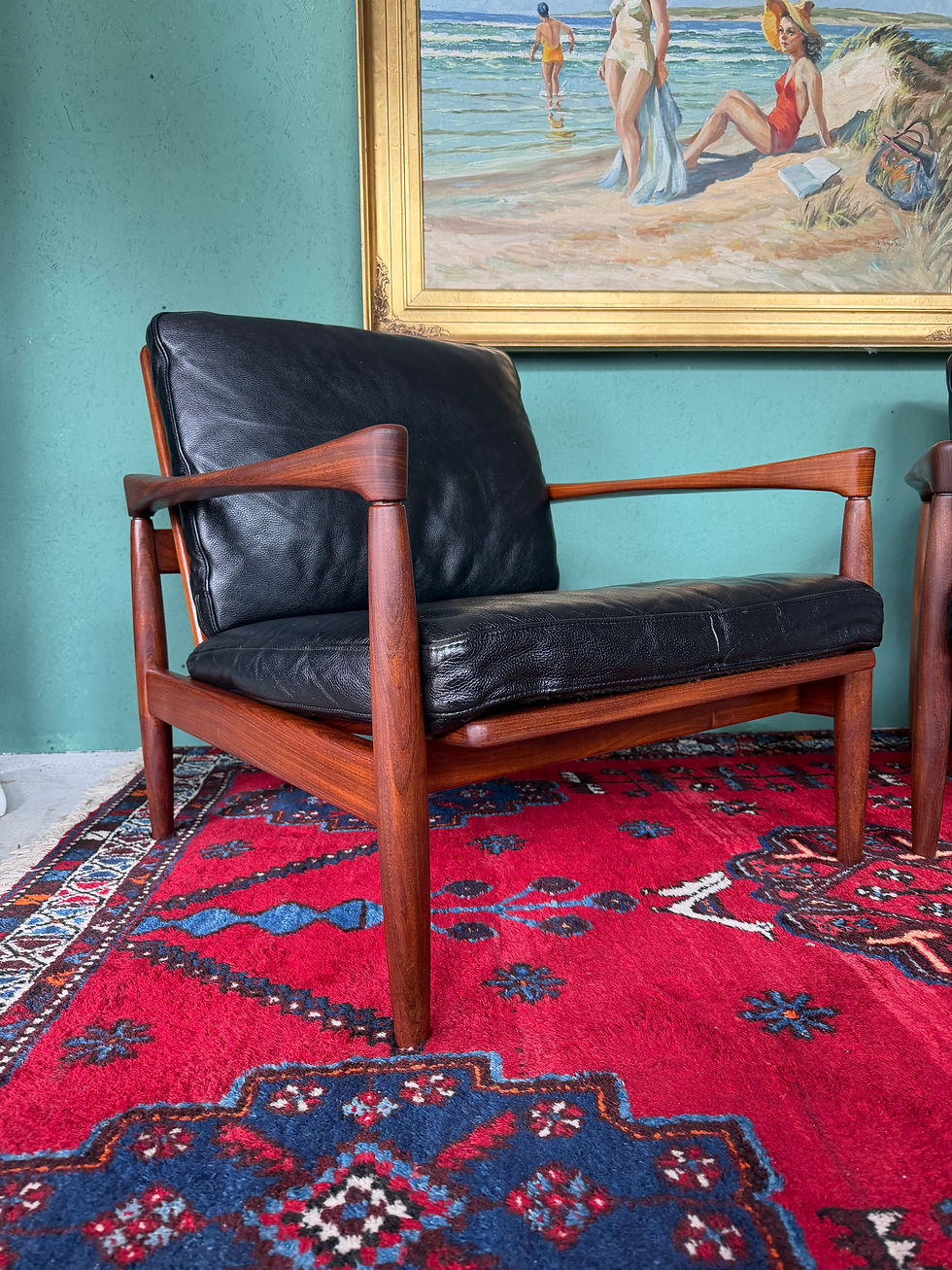
It’s honest. You can see how it’s made. Mortise and tenon joints, solid wood, visible craftsmanship. No hidden particleboard. In a world of flat-pack and fast furniture, that honesty feels rare.
It’s adaptable. The scale and proportions fit modern apartments. A Wegner chair from 1955 doesn’t look out of place next to an IKEA sofa from 2025. It’s timeless because it was never tied to a trend.
It ages well. Teak, oak, and rosewood darken and patinate. The scratches and marks become part of the story. People aren’t buying “vintage” as a look. They’re buying furniture that will outlive them.
That’s why a single dealer in Copenhagen can ship a container of lights and chairs to Australia, California, and Dubai in the same month.
The sustainability factor nobody talks about
“Circular economy” is a buzzword now, but Denmark did it by accident. These pieces were built to be repaired.
A PH 5 lamp from 1958 can be rewired. A Wegner chair can be re-upholstered and re-oiled. Compare that to a sofa from 2018 where the frame snaps and the foam disintegrates.
Younger buyers get it. Why buy new furniture every 5 years when you can buy a 60-year-old piece that’s already lasted 60 years and will go another 60? Shipping vintage Danish design is, weirdly, one of the most sustainable things you can do.

So how long can this continue?
This is the question every dealer and collector asks.
The honest answer: the supply of high-quality, unrestored pieces is finite. Denmark didn’t produce millions of Wegner chairs. They produced thousands. As more pieces end up in permanent collections, homes, and museums, the good stuff gets harder to find. Prices have climbed 200-400% in the last 10 years for designer pieces in good condition.
But here’s the other side: Denmark is still producing. The mid-century boom created a design culture that never stopped. Brands like Carl Hansen & Søn, Gubi, and Menu are still manufacturing updated versions of classic designs. And a new generation of Danish makers is making furniture that will be “vintage” in 2060.
So the flow won’t stop. What’s changing is the ratio. Ten years ago, 80% of what you found was original vintage. Today, it’s closer to 50/50 vintage vs. licensed reissues.
Why it matters beyond the furniture
Danish mid-century wasn’t just about chairs. It was a philosophy: design should improve daily life, not just look good in a magazine. That idea traveled. You see it in Japanese Muji, in Scandinavian tech startups, in the way we think about workspace and home now.
A small country with 6 million people couldn’t compete on size or resources. So it competed on ideas. And ideas don’t run out.

If you’re buying:
Look for solid wood, original joinery, and maker’s marks. Wegner, Jacobsen, Mogensen, and their manufacturers like Fritz Hansen and Carl Hansen are the safe bets. Expect to pay more for originals, but expect them to last.
If you’re selling:
Condition and provenance matter more than ever. A rewired lamp with original brass, a chair with intact joints and honest patina, will always find a buyer.
The Danish mid-century wave didn’t happen because Denmark was big. It happened because it was intentional. And intentional design doesn’t go out of style.


Comments